Sunday, 21 May 2017

How to prepare your patterns

Here's a checklist to help you prepare your pattern once it's all assembled. Follow it step-by-step to apply each correction in the right order.

1-Sizes
Check the body measurement chart. When you choose a size, find the measurement that is closest to yours. Sometimes your measurement is not exactly the same as the chart. In this case, choosing the size will depend on the garment fit. On a loose fitted garment, you can easily go with the largest size.  On the other hand, to keep a jersey dress, top or skirt closely fitted, you should choose the smallest size. With any other fitted garment, try the larger size so you can remove the excess as you are sewing, namely by sewing larger seam allowances in the side seams. If you are not comfortable with this technique, it is possible to grade the pattern in between sizes (see entry no.3).

Monday, 15 May 2017

Croquis templates UPDATED (FR + EN)

Each single page contains a fashion figure, front and back view, with very light outlines so you can draw on top of it. There is also a dedicated section at the bottom for fabric swatches and one for the trims & notions. Organize your sewing projects and note down any alterations or measurements in the note section. We have one for regular and plus size. All you need is to save the pictures below... And don't forget to print them in ACTUAL SIZE

English
 

Sunday, 14 May 2017

Tips to make your own jeans

To make its own jeans is somewhat of an ambitious project but if you want to improve your skills, you must up the game! Pretty much everybody wear jeans so why not try this out? Not only you'll be able to adjust the pattern to get the perfect fit but you will also have full control on the design and stitching details.

To make its own jeans is also an ethical choice! Globally, the jeans industry is not so great. Everyday, employees working in jeans factory are in contact with many chemicals (like the one used to wash the denims) which are compromising their health and the environment. Ethically made jeans can be very expensive and hard to find so making your own jeans equals perfect solution!

We hope you like this new tutorial to help you organize your DIY jeans project. We even have this cool template that you can use here.


Pictures by Anya Tsinko (www.anna-zoe.net) wearing her handmade skinny high waist jeans (TR803).

Saturday, 24 December 2016

Stay stitch

A good sewing pattern is useless if it is paired with poor workmanship. Stability and control are very important when sewing because your finished garment measurements must match with the pattern measurements. Straight edges which are cut along the weft or selvage are obviously stable and will resist against stretching. On the contrary, curved and oblique edges are unstable and can easily be deformed which can alter the fit of your garment and create plenty of unaesthetic details. This is when stay stitches enter the game, so let's have a quick look at these and how to use them.

One shoulder maxi dress, by Mugler
Wrap mini skirt, Won Hundred

Friday, 9 December 2016

Tips for sewing with corduroy

Whether it is for a vintage seventies look, in earthy tones or for a modern look, in vivid colours, corduroy fabrics are right here for you! Versatile, it can be used for  a wide range of garments such as pants, skirt, overalls, dresses, bodices and jackets. Its iconic ribbed texture and sturdiness require some precautions, and for this, we advise you to read our quick guide before you start your new project.

Trousers with wide leg, by P.A.R.O.S.H. 
Super long skinny trousers, by  Société Anonyme 
Jacket with lapel collar, by Yohji Yamamoto Vintage

Tuesday, 29 November 2016

Basic pants pattern corrections

Today, we target three areas where pants pattern correction are most likely needed. We'll focus on the upper part to achieve a perfect fit. Have your pants pattern ready, adjusted at the right size, and extra sheets of paper.


Seat adjustment: the back crotch length is not adequate. A full seat adjustment is needed when pants back waist tends to drop, because the length is not long enough. In contrast, a flat seat adjustment will fix the excess created below the buttock when the crotch is too long.

Monday, 11 July 2016

A simple guide to ironing fabrics

Here's a quick guide for ironing different types of fabric by setting the right iron temperature and using different tools to help you get rid of fabric creases.


Friday, 8 July 2016

How to sew a jeans fly

A jeans fly is a very popular type of closure used in trousers and skirts. It consist of a zipper concealed under the opening. It is attached on one side under a tab and the other side is attached to a facing, usually in a "J" shape. This is why the jeans fly pretty much always features a bold "J" shaped topstitch. Today I will show you how to sew a real one, like the ones from commercial jeans! Let's do this...


Monday, 4 July 2016

How to add sizes to a graded pattern

If you need to add more sizes to a pattern, follow these easy steps to make them magically appear! This technique is perfect if you bought the wrong size or even to enlarge or narrow down certain areas of a pattern. You can also use this technique to adapt a pattern for children or plus sizes. However, it is recommended to test the pattern on a muslin afterwards!


Tuesday, 28 June 2016

How to make adjustable straps

Adjustable straps are very easy to make and will bring your sewing projects to the next level! All you need is a pair of bra sliders and ring, which are very easy to find, and cheap, at your local sewing shop. Let's do this...

Wednesday, 15 June 2016

Guide to zipper teeth sizes

http://www.kommatiapatterns.com/2016/06/guide-to-zipper-teeth-sizes.html

#3, #4, #5 ... These terms, which you might have noticed when buying zippers, are simply used to indicate the gauge or size of  the zipper teeth. The system is very simple: the higher the number, the bigger the teeth are. The numbers also express the width of the teeth in millimetres. Choosing the right gauge is no big fuss either - the larger the teeth are, the studier is the zipper. Therefore, the zipper teeth must match with the fabric weight and thickness

Tuesday, 24 May 2016

Thursday, 19 May 2016

Knits 101... an introduction


Knit garments are very present in the fashion industry, since decades, and so are they in your wardrobe. You might eventually wish to make yourself a knit garment, but it is very important to know a few things about these knits. As the name indicate it, they are knitted and not woven, which make most of your sewing knowledges non-applicable for these. But this is no big deal... because today I will show you, in this article, the basics for sewing with knits. Once you've got through this article, you'll understand them better and will be sewing them with confidence! Let's do this...

Tuesday, 10 May 2016

Full seat adjustments


Today I will show you an easy and practical pattern correction to increase the back crotch length. This correction is essential as a trouser that drops a lot at the back can be very annoying and unaesthetic. As a matter of fact, this is the most frequent problem I have noticed on people, including myself. Let's put an end to this!

Friday, 8 April 2016

Bust cup adjustment on knit tops


Knit garments have the advantage of moulding easily on the body. This makes its fit is much easier than a garment made of non-stretch fabric. Nevertheless, a knit top made too small at the bust will not fit right and can deform the armholes or necklines. Our patterns are adjusted according to a B cup and we highly recommend that you adjust your patterns if you are a C or D cup. If you are unsure about your bust cup, click here to measure it.
 

Friday, 1 April 2016

Thursday, 31 March 2016

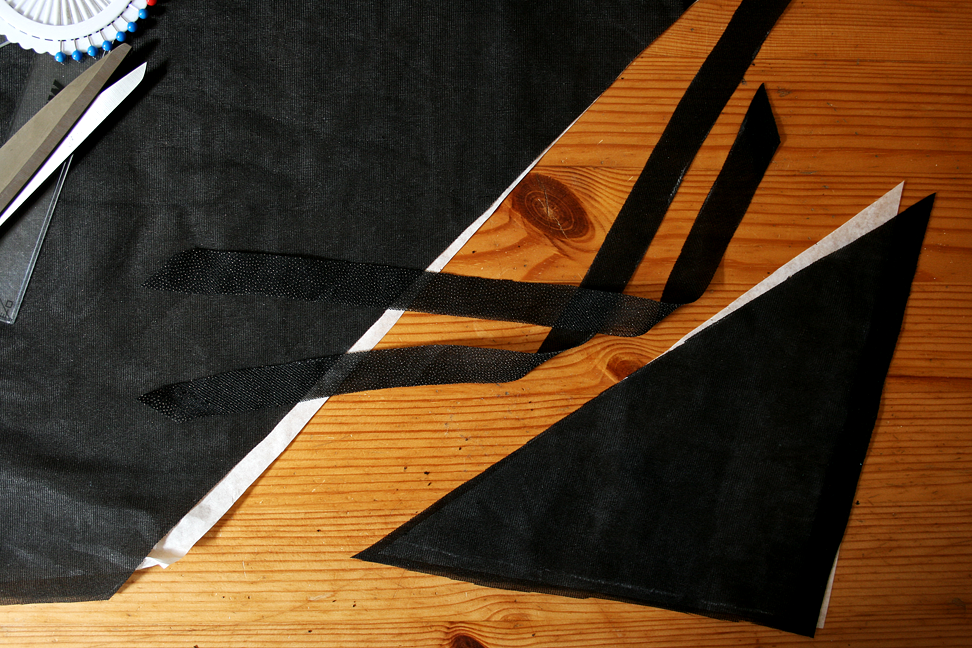
How to make fusible tape


Fusible tapes should not be dismissed when mentioned in a pattern. In fact, they are merely strips of interlining, precut for your convenience, but are essential to stabilize seams. If you don't have any fusible tape in hand, don't worry! They are easy to make using a piece of interlining. So, let's see how we do this ourselves... no fuss!
 

Needle types


"Sewing needles come in a variety of shape and size so here’s a handy guide to help choosing the right one depending on the fabric you are working with."